The missing piece that’s rarely spoken about
There’s a moment when new clients will seek me out in clinic.
They’re doing everything right, they’ve invested in their skin.
They’re consistent. Thoughtful. Committed.
And yet, they feel something has shifted.
Their skin doesn’t bounce back the way it used to.
Treatments don’t seem to land the same.
It feels… slower, less responsive, a little harder to move the gauge on results.
This is usually the point where people ask me if they need something stronger.
A different product. A more advanced treatment.
But most of the time, the conversation I have with them is that this is not the real issue.
What I’m often seeing isn’t a product problem – it’s a response problem.
This is the part that’s not always talked about
We tend to think about ageing in terms of sun exposure, hormones, or time.
But one of the biggest influences on how your skin behaves is much quieter:
stress.
Not just how it feels mentally – but what that stress is doing on an ongoing basis to our body wide systems.
When stress (even low level stress) isn’t resolved, your body stays in a heightened, fight or flight state. Cortisol ( considered your primary stress hormone) remains elevated for longer than it should, and over time, that begins to change how your skin responds and functions.
This has an insidious effect on the main structural protein in your skin (and body btw) – collagen
Collagen isn’t something you simply “lose.” Your body is constantly working to make it, organise it, and repair it.
For those processes to be able to function requires effective cell communication, energy, and a relatively calm internal environment.
When stress is unresolved for extended periods, those systems become less efficient.
The skin shifts from a place of steady renewal… to one where breakdown can outpace repair.
You might notice it as:
• softer structure through the face
• changes in texture and “feel” of the skin
• slower healing
• a general sense that your skin isn’t responding the way it used to
These changes might be subtle at first – but they’re very real.
Why your treatments might feel different now
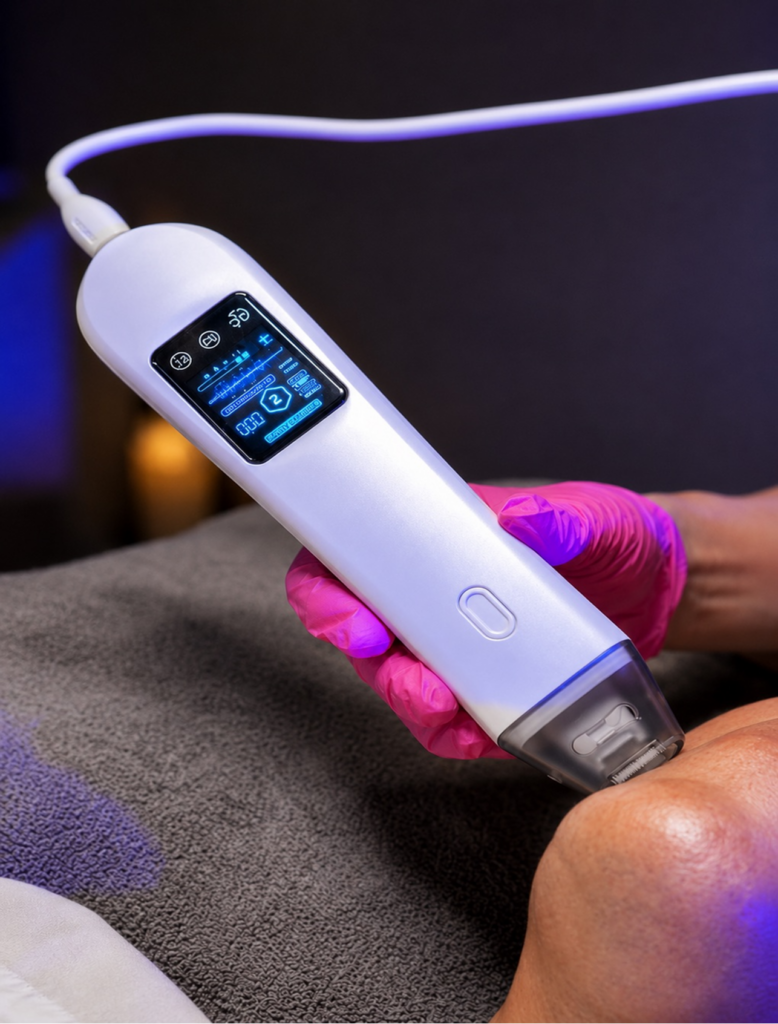
Many advanced skin treatments – whether it’s needling, peels, or regenerative facials work by encouraging collagen production.
But here’s the part that really matters: Stimulation only works when the skin has the nutrition and capacity to respond.
If your system is running under stress, inflammation is higher, or cellular energy is low, the skin won’t be able to use that stimulation as effectively.
So instead of better results, you might experience:
• slower recovery
• less visible change
• results that don’t last as long
It’s not that your treatments or homecare regime is wrong. It’s that the environment it’s working within has changed.
This is the shift I tend to make in clinic
Rather than pushing the skin harder, I shift the focus to supporting it more completely and on several levels.
Because collagen isn’t built and sustained through force. It’s built when it has the right conditions, support and nutrients
When the skin feels “hard to treat, or non-responsive,” I find it’s usually asking for support first – not more intensity.
There’s also a space where topical support comes in
This is where the collagen-stimulating ingredients I use and recommend in clinic become incredibly valuable. I’m not talking about collagen itself – but the ingredients that help your skin produce and organise its own collagen more effectively.
Rather, leaning to targeted peptides and regenerative actives that act as messengers, because they encourage the skin to function more efficiently – supporting repair, structure, and resilience over time.
When used well, and at the right time, these ingredients help guide collagen production, support how the skin rebuilds and strengthens and improve how treatments integrate and hold
But I’m very clear within my conversations that these ingredients work best when the skin is in a position to respond.
And the inside-out piece
This is where internal support can significantly make a difference.
Correctly formulated, hydrolysed collagen peptides don’t just “add collagen” to the skin. They break down into small bioactive chains that your body can use as signals and building blocks.
Over time, I find that they can support collagen density, skin resilience and importantly – overall structural integrity
They’re certainly not a quick fix, and they’re not a replacement for my recommended skin care.
But I find that when they’re used consistently and paired with the right topical and treatment approach, they become part of a much bigger picture.
Why I always say support always comes before correction
You can have: the best products, the most advanced treatments and the right supplements. But if the skin is working in a stressed, depleted environment,
results will always be self-limiting.
Because skin doesn’t repair well when the nervous system is constantly elevated, circulation and lymphatic flow are reduced, with inflammation sitting in the background
which means cellular energy is low.
This is why my work doesn’t just begin with automatically doing more to the skin.
I begin with changing how the skin is able to respond.
What this looks like in my practice
I start by supporting the foundations of good skin:
barrier.
structure.
circulation.
nervous system.
energy.
Then- and only then – I will start to layer in: targeted treatments, collagen-stimulating ingredients and internal support where appropriate
So the skin isn’t being pushed… it’s being guided.
What changes when this is in place
The shift becomes noticeable, skin starts to respond again- you’ll see treatments begin to land the way they should, improved results don’t just appear – they hold. And perhaps most importantly of all – you stop feeling like you need to keep chasing the next thing.
Finally, I always like to talk to people about a different way of thinking about collagen.
Stop thinking about collagen production as something we need to force, instead, think of it as something we support the body to create and maintain, over time.
This means looking both at what we apply to the skin, and what we support within the body.
Outside in. Inside out.
This is how I work with skin.
Curated Skin & Wellness
Auckland | Hibiscus Coast