T33 Ultra Cold Plasma: A Different Way of Thinking About Skin Regeneration
Not every breakthrough in skin therapy comes from a new ingredient.
Sometimes it comes from understanding biology differently. After more than 30 years treating skin, I’ve become increasingly interested in one question:
How do we help skin function better, rather than simply making it look better?
That’s exactly why I have introduced T33 Ultra Cold Plasma to Curated Skin & Wellness.
I have secured one of the first devices of its kind in New Zealand, but that isn’t why I chose it. I chose it because it aligns with everything I believe about healthy skin.
Rather than forcing change through injury alone, T33 works by communicating with the skin through carefully controlled plasma energy, supporting many of the biological processes involved in repair and regeneration.
To understand why that’s exciting… we first need to understand what plasma actually is.

What is plasma?
Most people learned at school that matter exists as:
- solid
- liquid
- gas
There’s actually a fourth state of matter – plasma.
When energy is added to a gas, some molecules become ionised. The gas now contains electrons, ions, reactive oxygen species, reactive nitrogen species and other energetic particles. Together these create plasma.
Although that might sound futuristic, plasma isn’t new.
Plasma is all around us: Lightning is plasma, the Northern Lights involve plasma, the sun is largely plasma.
Medicine has also been using different forms of plasma for years.
The latest and, to me, most exciting development is that researchers have now learnt how to generate cold atmospheric plasma that operates close to body temperature, making it suitable for skin applications. Unlike older thermal plasma technologies designed primarily to resurface skin through heat, this form of cold atmospheric plasma aims to trigger biological signalling while minimising thermal injury.
Why is it called Ultra Cold Plasma?
One of the first questions people ask is:
“If it’s plasma… won’t it burn?”
No.
Traditional plasma devices generated significant heat.
Ultra Cold Plasma is very different.
The temperature remains close to skin temperature, allowing biological effects to occur without the high temperatures associated with traditional resurfacing treatments. That means less thermal damage and generally much less downtime than older plasma technologies.
So what is actually happening inside the skin?
This is where plasma becomes fascinating.
For many years we assumed reactive oxygen species (ROS) were simply harmful “free radicals.” We now know biology is much more nuanced. Your cells actually produce small amounts of reactive oxygen and nitrogen species every day.
In the right amount, they act as signalling molecules.
These molecules tell our skin cells to repair, communicate, defend and renew.
Cold plasma temporarily increases these signalling molecules in a controlled way, encouraging normal healing pathways without creating the level of tissue destruction associated with many older rejuvenation procedures. Research suggests these reactive species can influence inflammation, collagen remodelling, angiogenesis, antimicrobial activity and wound healing responses.
T33 isn’t simply trying to damage the skin
Many skin rejuvenation treatments work because the body repairs controlled injury and that principle has served our profession well for many years.
But skin biology is evolving.
Rather than asking:
“How much injury do we need to create?”
We can now ask:
“How much communication does the skin need?”
That’s one of the reasons T33 resonated with me. Instead of relying primarily on thermal damage, it works through biological signalling.
For me, that’s a very familiar philosophy, as this underpins everything I do at Curated Skin and Wellness.
Why this fits the Curated Skin philosophy
Anyone who has visited my clinic knows I don’t believe healthy skin starts with chasing wrinkles. I believe healthy skin starts with function.
When skin functions well, it generally becomes:
- stronger
- calmer
- more resilient
- better hydrated
- more efficient at repair
Everything I do is built around supporting those processes.
That’s why I often say:
Outside in. Inside out.
No device replaces sleep.
Nutrition.
Hormonal health.
Stress management.
Movement.
Inflammation control.
Skin care.
Instead, treatments should work alongside them. T33 fits beautifully into that philosophy.

What skin concerns may benefit?

Because T33 works by supporting skin function rather than targeting a single problem, it may be incorporated into treatment plans for concerns such as:
- skin ageing
- reduced firmness
- uneven texture
- enlarged pores
- acne
- post-acne marks
- certain acne scars
- redness
- compromised skin barrier
- dull skin
- pigmentation (as part of an appropriate treatment programme)
Treatment suitability always depends on the individual. During consultation we assess your skin, health history and goals before deciding whether T33 is appropriate.

Is T33 better than microneedling or your other treatments?
Microneedling remains an excellent treatment, and one that I continue to offer when appropriate.
Chemical peels still have a place.
LED remains valuable.
Skin boosters have an important role to play in skin health.
Rather than replacing everything else…T33 gives us another way to support skin physiology.
Sometimes it may be used on its own , other times, I’ll recommend it alongside other regenerative treatments, and always as part of a broader treatment programme.
My philosophy is that the right treatment is always the one your skin actually needs.
What makes T33 different from many cold plasma devices?
Not all cold plasma technologies are identical.
Different systems vary in:
- plasma stability
- energy delivery
- electrode design
- treatment consistency
- treatment protocols
These differences influence how plasma is generated and delivered to the skin, so results and treatment experiences can vary between devices. That is why it is important not to assume all “cold plasma” treatments are interchangeable.
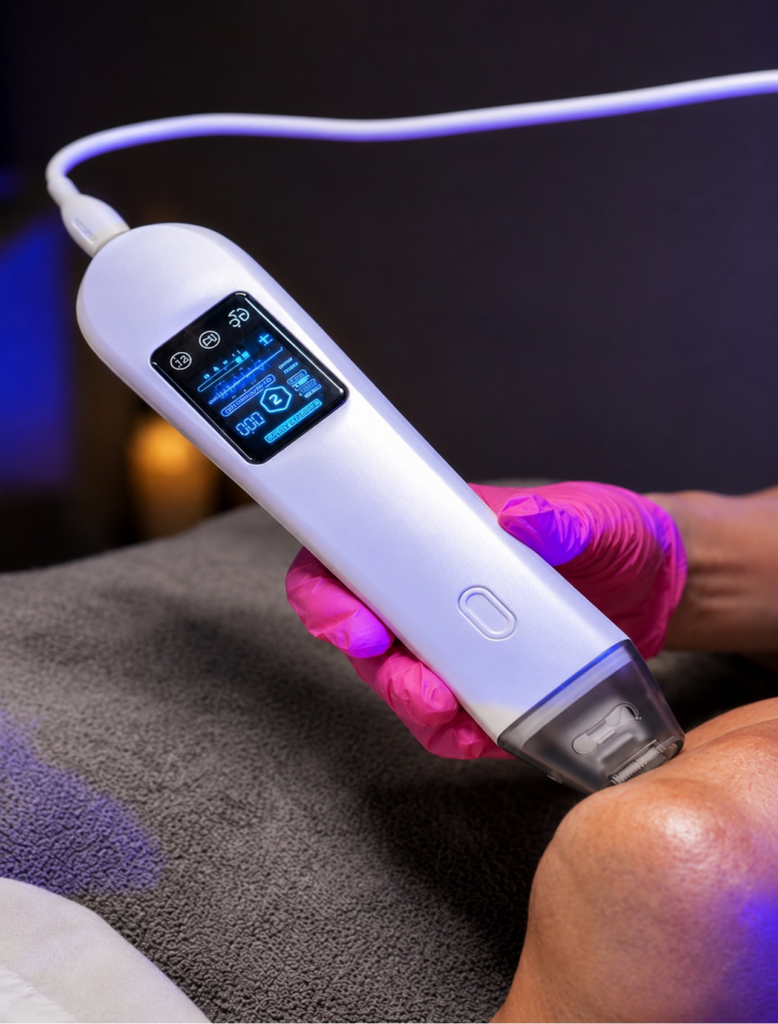
What happens during treatment?
Treatment begins with preparing the skin.
The T33 handpiece is then moved methodically across the treatment area. Depending on your treatment plan, additional regenerative products may also be incorporated.
Most appointments take around an hour.
Downtime is typically minimal, although this varies depending on your skin and treatment protocol.
Is there scientific evidence?
Cold atmospheric plasma has become one of the fastest-growing areas of plasma medicine.
Research is investigating its role in:
- wound healing
- skin regeneration
- antimicrobial activity
- inflammation modulation
- collagen production
- tissue repair
While research continues to evolve and individual device evidence differs, the broader body of work around cold atmospheric plasma is increasingly encouraging.
Why I chose T33
Every few years something genuinely changes the way I think about skin. This was one of those moments.
Not because it’s new, but because it makes physiological sense.
After spending decades studying skin biology, fascia, inflammation, longevity, menopause and cellular health… T33 felt like a natural extension of everything I already believe.
Helping skin function better, not fighting it. Supporting it, listening to its biology and working with it rather than traumatising it
That’s exactly what Curated Skin & Wellness has always been about.
Experience Skin Through the Curated Skin Lens
If you’re looking for a treatment that simply promises younger-looking skin, there are many options available.
If you’re interested in supporting healthier, stronger, more resilient skin by working with its biology, I’d love to show you what’s possible.
Book a consultation at Curated Skin & Wellness in Auckland and discover whether T33 Ultra Cold Plasma is the right treatment for your skin.